Much of America has already moved to on-cycle elections. The share of cities that hold even year November city council elections has almost doubled - from less than 20 percent before 1995 to just over 37 percent today (Warshaw and de Benedictis-Kessner 2024). Mayoral contests have also moved toward consolidation. The share of mayoral elections held in November of even years has more than doubled from 14 percent to 33 percent over the same period (Warshaw and de Benedictis-Kessner 2024). Change has been just as substantial at the school district level – although exact estimates are hard to come by.
Moreover, it appears that the shift to on-cycle elections is accelerating. In just the last decade, five states (California, Arizona, Nevada, Virginia, and New York) have passed laws requiring on-cycle contests. A sixth state – West Virginia – enacted legislation that allowed for or required on-cycle elections in the state. In major cities, the share of on-cycle contests has grown from just 28 percent in 2005 to 42 percent in 2023 (Sightline Institute 2024). In those states and in several others that allow individual cities to set their own timing, hundreds of communities and a likely over a thousand school districts have shifted to consolidated elections.
1
2
Anzia (2014) reports that between 2001 and 2011 over 200 bills focused on election consolidation across the country. Roughly half of these (102) focused specifically on aligning school board elections with federal and statewide contests. Twenty-five of those bills became law.
Hartney and Hayes (2020) indicate that “The majority of California’s districts moved from odd-year (off-cycle) board elections in the 1990s to November even-year (on-cycle) elections by 2018.”
1
2
States Have Shifted
In the last ten years five different states have passed laws requiring on-cycle contests. California was the first to move - passing and implementing the California Voter Participation Rights Act in 2015. That act required cities with turnout below a threshold to move to on-cycle elections. Soon after the measure was enacted, cities across the state started shifting to even year contests. Today, 96 percent of all cities in the state hold local municipal elections on-cycle (Hajnal et al 2022, Sightline 2024). Arizona followed California by passing a similar bill in 2018. Then in 2019, Nevada passed Assembly Bill 50 requiring all municipalities in that state to align their elections with state and federal elections. Following passage, Las Vegas, North Las Vegas, and Henderson move to consolidated elections. Three years later Virginia implemented a bill that shifted all municipal elections for city and town councils as well as school boards to November to align with either statewide odd year or federal even year elections. Most recently, New York state passed a measure that requires all town and county elections to be consolidated. That bill was challenged in court and its implementation awaits a court decision. One other state – West Virginia – enacted legislation that allowed all counties to hold on-cycle elections and required some types of contests to be aligned with statewide elections.

Cities Have Shifted
In New Jersey alone 45 municipalities have reportedly aligned their local elections with state elections (Citizens Project vs Colorado Springs 2022).
3
In these states as well as in several other states that allow cities to switch their own timing, there has been widespread movement toward consolidated elections. Across the county, well over 100 municipalities and districts have made the switch to even year elections in recent years. The figure below highlights some of the major cities that have shifted to consolidated elections.

3
Effects on the Vote and Turnout
The net effect of these different moves to consolidated elections around the country has been massive. It has increased the number of voters participating in these contests. And equally importantly, it has altered the composition of the vote in these elections – making the vote more representative of the underlying population. Because of election timing reform, voters in local democracy are now younger, more racially diverse, and more economically diverse than they were a decade ago.
The effects on turnout are clear. Every study that has examined election timing and voter turnout has found that moving to on-cycle elections greatly increases turnout (Warshaw and de Benedictis-Kessner 2024, Einstein et al 2024, Collins et al 2020, Schaffner et al 2020, Marschall and Lappie 2018, Kogan et al 2018, Anzia 2014, Holbrook and Weinschenk 2013, Hajnal 2010, Berry and Gerson 2010, Caren 2007, Hajnal and Lewis 2003, Wood 2002, Hajnal et al 2002).
The gains in turnout that come with the move to consolidated elections can, however, best be seen by tracking turnout in individual cities as they change the dates of their elections. The table below tracks those changes for all major cities for which researchers have been able to compile turnout figures. It shows how turnout changed from the last off-cycle election immediately preceding the shift in timing to the first on-cycle election after the timing shift. The table shows that turnout increased in every city that switched to on-cycle dates. The data show not only that turnout increased in every case but also that gains were dramatic in every case. Voter turnout was 3.9 times higher on average after the switch than it had been in the same city before the switch. That corresponds to an increase in turnout from an average of only 16 percent in the last off-cycle contest in each city to an average of 54 percent in the first November on-cycle election immediately after the shift.
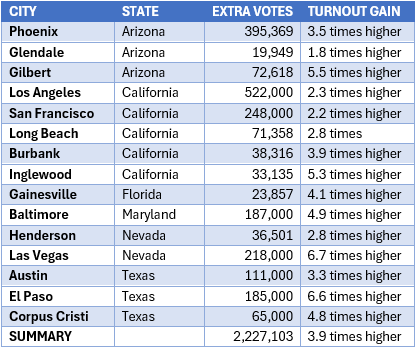
Those gains are not unusual. A study of 54 municipalities in California that switched from off-cycle elections to on-cycle elections found that average turnout in those cities was 25 percent in the two elections immediately preceding the switch and 76 percent in the elections immediately following the switch (Meneses and Spencer 2021). That represents a 300 percent increase in votes cast (Meneses and Spencer 2021).
When all of these gains in turnout are added together, the impact on local democracy is profound. Across the 15 cities in the table, turnout grew by more than 2.2 million voters from one election to the next. In the 54 California municipalities studied by Common Cause (almost all of which are not included in the table above) turnout tripled. All told, that translates to an increase of more than 700,000 votes in those California municipalities (Meneses and Spencer 2021). With comparable turnout gains for the many other cities and multitude of school districts where timing has shifted but researchers have not yet compiled data, the net gain is likely to surpass 5 million votes. When all of New York’s towns and counties switch from off-cycle to on-cycle contests, the net effects on voter turnout across the national could surpass 10 million. Simply by changing the dates of local elections, local reformers are likely to have added more than 10 million new voters to local democracy.
The shift to consolidated contests not only impacts how many people vote, it also affects the degree to which voters reflect the underlying community population. The range of studies that have examined the composition of the vote find that moving to consolidated elections makes the electorate younger, less white, and less wealthy – all changes that make the vote more representative of the residents living in these cities (Hajnal et al 2022, Schaffner et al 2020, Kogan et al 2018). Those demographic shifts can also often best be seen by looking at changes in turnout as cities undergo the move from off-cycle to on-cycle contests. That same study of 54 California cities found that turnout gains were more pronounced in more diverse cities. Indeed, cities home to historically underrepresented communities saw some of the biggest gains – from turnout that averaged under 16 percent to turnout that averaged over 70 percent. Pico Rivera, with a population that is over 90 percent Hispanic, saw turnout by more than 500 percent (Meneses and Spencer 2021). Because of election timing reform, voters in local democracy are now younger, more racially diverse, and more economically diverse than they were a decade ago.
Fewer, Better Elections: Timeline
2011
- New Jersey lawmakers give communities which hold May local elections the option to consolidate them to November state election dates. In the years that follow, 45 cities and towns choose to do so, including Trenton and Jersey City. Turnout rises and elections cost fall. (Source)
2012
- Baltimore, Maryland, which had long held local elections in odd years, choose to move to even years.
2015
- California Democrats pass a law that requires all municipalities with low local voter turnout to move local elections to even years. In the years since passage, some 50 cities move to even year elections.
2016
- Baltimore holds its first even year municipal election.
2018
- Arizona Republicans pass a similar even-year elections law. Following passage, every major city in the state save Tucson (including Phoenix, Scottsdale, Chandler, Gilbert, and Mesa) moves to even year elections.
- Sarasota, FL, voters choose to move local elections to even years.
2019
- A bipartisan coalition in Nevada pass a similar even-year elections law. Following passage, all cities including Las Vegas, North Las Vegas, and Henderson move to consolidated elections.
2020
- Monument, CO, votes to move its elections to even year November dates. (Source)
2022
- Virginia passes a law requiring all municipalities to move to November elections. The law lets communities choose to align with either federal elections in even years or state elections, which are held in odd year Novembers.
- On November 8, Los Angeles voters vote in even year elections for mayor and city council for the first time. Turnout crests over 1M, reaching some 43 percent out of the 2.1M registered voters in the city, crushing the 20 percent (2017) and 23 percent (2013) turnout of recent past city elections. Karen Bass wins, becoming the first Black woman mayor of the nation’s second largest city.
- Voters in 12 communities vote in ballot questions to decide if their municipalities should move local elections to even years. All 12 communities vote yes, including Boulder and Fort Collins, CO; St. Petersburg, FL; King County, WA; as well as San Francisco, San Jose, Long Beach, and five other CA cities.
2023
- New York state passes a law requiring all counties and towns to move to November even year elections.
2024
- Idaho, Montana, New York, and Washington consider legislation to consolidate local elections.